Introduction
Search is no longer limited to traditional search engine results pages. Today, users can receive information directly from AI-powered tools that summarize content, answer questions, and provide recommendations in real time. This evolution has sparked widespread discussion around AEO vs SEO and what it means for digital marketing strategies. Recent industry discussions suggest that visibility is increasingly determined not only by rankings but also by whether a brand’s content becomes part of AI-generated answers.
For businesses seeking long-term visibility, understanding AEO vs SEO is becoming a strategic priority.
Understanding AEO vs SEO
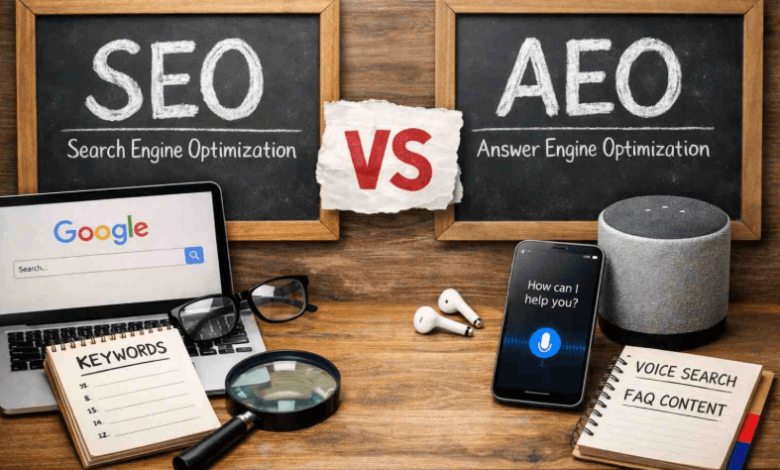
At its core, AEO vs SEO compares two approaches to online discoverability.
SEO focuses on helping webpages rank within search engine results. AEO focuses on helping content become part of the answers delivered by AI systems, voice assistants, featured snippets, and conversational interfaces.


Although the objectives differ, both approaches depend on content quality, relevance, and authority.
Why Search Is Evolving
The growing interest in AEO vs SEO is driven by changes in user behavior and technology.
Consumers increasingly use conversational queries instead of short keyword phrases. AI-powered systems can interpret these questions and provide synthesized answers without requiring users to visit multiple websites. Research suggests that AI-generated responses often rely on different information sources and content structures than traditional search results.
This creates new opportunities and challenges for marketers.
Core SEO Principles Still Matter
A common misconception in the AEO vs SEO debate is that SEO is becoming obsolete.
In reality, SEO continues to provide the technical and editorial foundation that answer engines rely on. Crawlability, indexing, authority signals, structured content, and relevance remain critical factors for visibility.
Businesses should view AEO as an extension of strong SEO practices rather than a separate discipline.
How AEO Changes Content Strategy
Focus on Questions and Answers
AEO encourages brands to create content that directly addresses user questions in clear language.
Improve Content Structure
Organized headings, concise summaries, and FAQ sections make information easier for AI systems to process.
Prioritize Authority and Trust
Answer engines tend to favor content from credible and authoritative sources.
Optimize for Natural Language
Modern search increasingly reflects how people speak and ask questions rather than how they type keywords.
Measuring Success in AEO vs SEO
Another important distinction in AEO vs SEO involves performance measurement.
SEO traditionally focuses on rankings, traffic, and click-through rates. AEO introduces new indicators such as AI citations, answer visibility, brand mentions in generated responses, and inclusion within conversational search experiences.
As answer engines continue evolving, marketers may need to expand their reporting frameworks beyond traditional SEO metrics.
See also: Verified Tech Hotline 0570072019 Trusted Corporate Connection
Building a Unified Search Strategy
The most effective response to the AEO vs SEO debate is not choosing one over the other.
Businesses should invest in:
- Strong technical SEO foundations
- Authoritative content
- Structured information architecture
- FAQ and answer-focused content
- Consistent topical expertise
- Brand trust signals
Together, these elements support visibility across both traditional search engines and AI-driven answer systems.
Conclusion
The future of search is not defined by AEO vs SEO as competing approaches. Instead, the future belongs to organizations that successfully combine both.
By maintaining strong SEO fundamentals while adapting content for answer engines, businesses can improve visibility, strengthen authority, and remain discoverable in an increasingly AI-driven search landscape.